Every so often, I’ll be piloting some sensor-laden, software-defined press car down a dark stretch of highway when an oncoming driver’s high beams arrive like a targeted retinal strike, an involuntary reminder that modern automotive lighting has entered its own lumen arms race.
Anyone who has driven at night in the last few years knows what I'm talking about: A modern crossover crests a hill in the opposite lane, and the cabin briefly fills with enough cold-white light to suggest a police helicopter has joined traffic. The obvious assumption is that drivers are simply leaving their high beams on more often, but the reality is more complicated.
An old problem
Before cars became the modern mode of transportation, horse-drawn carriages used oil lanterns to light the way, as roads were largely unlit outside of towns and cities. These lanterns weren’t particularly bright, though, meaning that after-dark collisions and near-misses were common.
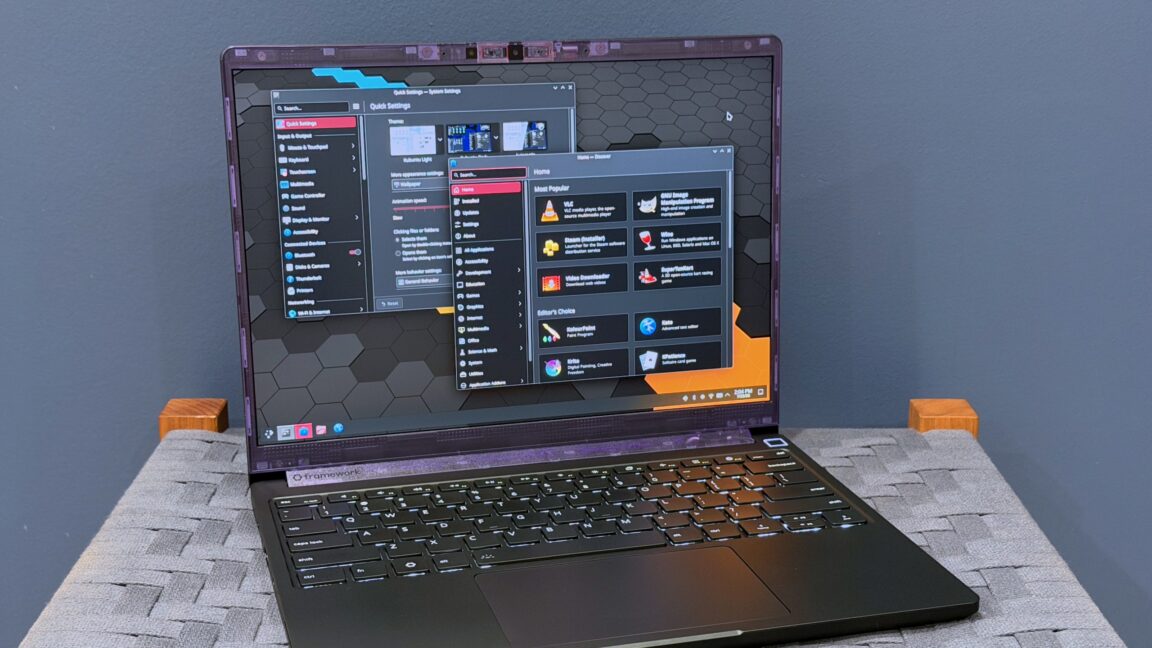
I've liked the Framework Laptop 13 since the first time I used it, partly because I just think the idea of a repairable and upgradeable laptop is cool and partly because it's not Yet Another Ultraportable Trying To Be A MacBook Air Clone. But the design has always had real shortcomings—the most noticeable and serious being its mediocre battery life.
Enter the Framework Laptop 13 Pro. While all previous Laptop 13 refreshes have tinkered around the edges with the original design (a tweaked lid design here, new hinges or new speakers there), the Laptop 13 Pro is as close as we've gotten to a second-generation revision for the original design.
This means that it breaks backward compatibility for some (but not all) Laptop 13 components, most notably the bottom case, the keyboard and trackpad, and the original 55 WHr and 61 WHr battery designs. But by allowing itself to make larger changes to the design, Framework has made major strides in battery life and general fit and finish.
Keychron has introduced ZGM, short for Zephyr Gaming Mouse, an open source firmware project built for gaming mice.
It is built on Zephyr RTOS, the same real-time operating system that already powers ZMK for keyboards. In its announcement, Keychron portrayed the launch as a philosophy rather than a marketing angle, stating, "Open source isn't marketing for us. It's the default."
Keyboards have QMK. They have ZMK. Mice have… nothing. 🔒
Every gaming mouse on the market runs firmware you can't read, can't audit, can't change.
So we built it ourselves.
ZGM — Zephyr Gaming Mouse. Open-source firmware for gaming mice, coming Q1 2027. The G6 HE will run… pic.twitter.com/naSdDXeMBh
The firmware is set to debut alongside the Keychron G6 HE, with a launch window sometime between January and March 2027.
The details
ZGM isn't a mouse, and it isn't a driver or third-party tool you install after buying one either. It's firmware that runs directly on a mouse's own hardware, and only devices built with it will run it.
The G6 HE is the first confirmed device, and any wider adoption depends on whether other manufacturers choose to build around it. The project is released under the GPL-3.0 license, so anyone can inspect the code, modify it, or fork it for their own hardware.
Currently, it is in a very early stage of development, where the repository mainly holds project scaffolding and policy files right now. Keychron says firmware sources, board support, and flashing guidance are still being prepared.
The plan is for the project to grow into full Zephyr-based firmware, with configuration layers for different hardware variants and integration for sensors, buttons, scroll wheels, and lighting.
Wired support is expected to arrive first, with wireless support to follow, alongside build instructions, example hardware targets, and testing guidance for latency and reliability.
Want even more?
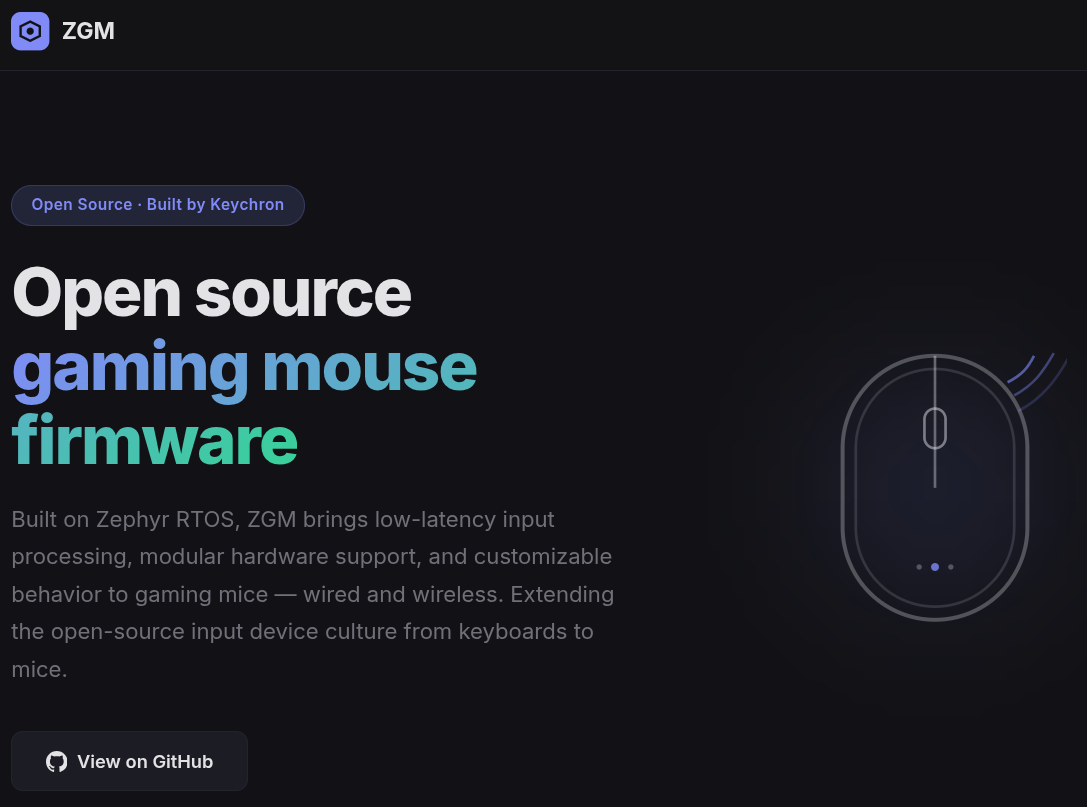
Just a placeholder pic of the ZGM website.
Keychron plans to support the chips Zephyr already works with, plus the sensors, buttons, scroll wheels, and lighting that go into a gaming mouse. Battery management for wireless builds is part of the plan too.
The roadmap starts where the project is now, then moves to building the actual firmware. After that comes getting buttons, scrolling, and sensors working, followed by basic USB support for wired mice.
Later steps cover different hardware setups, testing for lag and stability, and eventually wireless support and more customization. The peripherals manufacturer says this is just a tentative plan for now, not a fixed schedule.
Keychron already builds keyboards around QMK and is already going towards ZMK. Both firmwares have proven that open source software can deliver deep customization and long-term reliability through years of community development.
And, as mentioned earlier, ZMK already runs on the same Zephyr foundation ZGM uses, which likely shaped Keychron's choice to build on it for their new mouse instead of starting from scratch.
That said, ZGM has a long way to go before it matches either project. QMK and ZMK both carry years of contributions, documentation, and supported hardware, while ZGM's repository only has planning material.
Linux users gain from this
Gaming and productivity mice rarely ship with official Linux support. Most peripheral makers build their configuration software for Windows and macOS only, leaving buttons, DPI stages, and lighting profiles locked behind an app that never gets a Linux release.
Linux users are left relying on community projects that reverse engineer these devices instead, and even then, support only covers whatever protocols someone has bothered to document.
I personally use two Logitech mice, the G502 HERO and a wireless one that comes with the MK470 bundle, and neither has official software support on Linux. Both work fine plugged in directly, but configuring them means turning to third-party tools like Piper or Solaar.
If more manufacturers pivot towards an open solution like ZGM, us Linux users could at least get some QMK-like support (but for mice). Imagine the kind of keybinds and macros you could play around with.
To celebrate the launch of Assassin's Creed Black Flag Resynced later this year, Ubisoft has teamed up with Unsolved Hunts to give players a chance at winning $500,000.
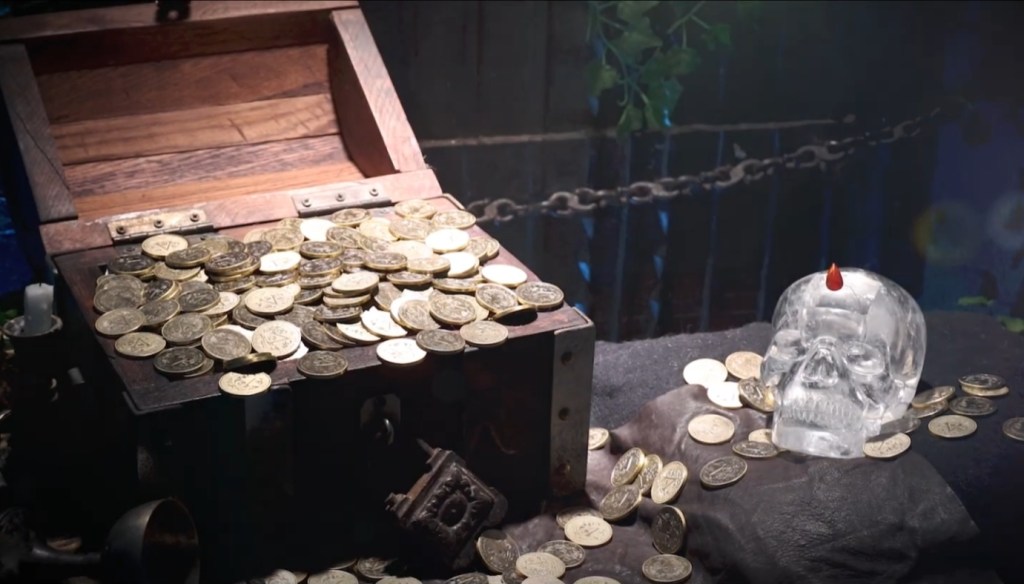
Together, Ubisoft and Unsolved Hunts have created a real-world treasure hunt called "Gold & Crystal - The Lost Treasure of Edward Kenway." The hunt is said to span multiple years, involve solving over a dozen riddles, and require traveling to the middle of the Caribbean Sea to uncover real buried treasure—a chest containing gold coins and a crystal skull with an opal. In total, the chest is said to be worth roughly $500k, with $350k of that being gold and the remaining $150k for the crystal skull.
To find the treasure, you have to solve a series of 15 riddles that are centered around the golden age of piracy to uncover a specific location in the Caribbean Sea. The first person to correctly guess that location will be flown out there to dig up their buried treasure.
The treasure you could win for completing the Gold & Crystal hunt. Screenshot via Ubisoft
While this treasure hunt is being thrown to celebrate the release of Black Flag Resynced, participants don't need to have any knowledge of the game or the Assassin's Creed franchise to play. However, participants who have played Black Flag will notice a number of references to the game, Edward Kenway, and other characters.
You don't need to purchase Black Flag Resynced to enter the treasure hunt, but you will have to spend some money to start uncovering the treasure. On the Gold & Crystal website, you can pre-order one of seven "Packs" that give you access to the entire experience, which is completely remote.
The starter pack, which is all you need to play, costs $35 and comes with access to the digital interface for the treasure hunt. However, you can spend $60 and up to also receive a physical copy of the game, containing maps, a bottle, letters, and everything else you need to solve all 15 riddles. There are additional packs for up to $230 that come with additional investigative games, real-world collectibles, and some Black Flag memorabilia.
The Gold & Crystal treasure hunt doesn't officially begin until Nov. 9, 2026, but pre-ordering one of the packs will let you access a sneak peek of what to expect and a clue to solving the first riddle. If you do pre-order, you can technically solve the first riddle before the treasure hunt even gets underway, but don't expect the riddles to be simple whatsoever.
While the clue will certainly help whoever decides to embark on the treasure hunt, Gold & Crystal states that the hunt will last between two and five years.
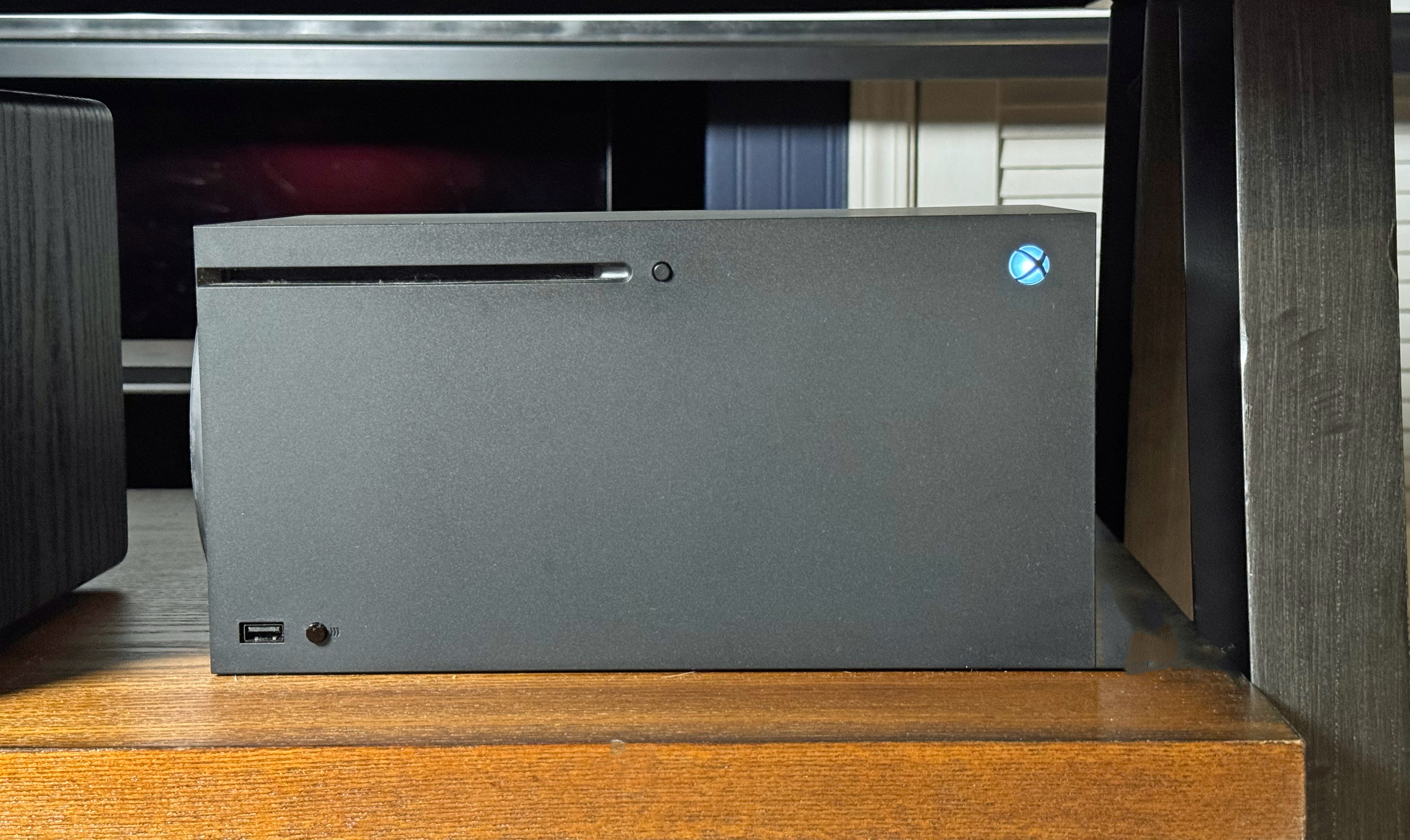
Want to see a dead body? I present to you the Xbox. After a subdued launch at the height of the COVID pandemic in 2020, the Xbox Series X quickly lost the fight against the PlayStation 5. Microsoft simply couldn't deliver enough compelling games, despite somehuge acquisitions, while Sony leaned on its goodwill from the PS4 era and a handful of desirable exclusives. As prices rose due to supply chain issues and the Trump administration's volatile tariff scheme, there was even less of a reason to get an Xbox (even the cheaper Series S). When I re-reviewed the Series X last year, it was clear that it never lived up to its potential. Anyone in their right mind would be better off buying a PlayStation 5.
Making things worse this year, Microsoft raised prices across the board, with the Xbox Series S starting at $400 and the cheapest Series X going for a whopping $600. And slow sales prompted Costco to stop selling Xbox consoles entirely. Microsoft didn't even try to push systems during Black Friday — why go through the trouble of having sales if nobody is buying the hardware in the first place?
Even Game Pass, which was once renowned as one of the best deals in gaming, almost doubled in price over the last year, reaching up to $30 a month (or $360 a year) for the Ultimate tier. Sure, Microsoft tried to add more value to its cheaper Game Pass tiers, and finally upgraded its cloud streaming platform, but the lack of consistent must-play exclusive titles has devalued the service (and Xbox as a whole). Avowed and South of Midnight were among the few exclusive highlights, but the latter will hit PS5 and Switch 2 next year. There's no word on Avowed reaching other consoles yet, but given Microsoft's current trajectory (and the fact that it's a genuinely great game), I wouldn't be surprised if it becomes available elsewhere.
There was a chance for Microsoft to reinvigorate the Xbox brand with the ASUS ROG Xbox Ally and Ally X gaming handhelds, but the $600 and $1,000 launch prices placed them out of reach for most gamers. It also doesn't help that Windows still isn't well-optimized for portable devices with touchscreens, and those systems also aren't compatible with older Xbox titles like the consoles. At the very least, Microsoft now has a handheld foothold. But a future portable Xbox console would need to be significantly cheaper to compete with the likes of the Steam Deck, which starts at $549 (following the discontinuation of the $400 LCD model).
And speaking of Valve, the company's recently announced Steam Machine has also stolen a lot of potential thunder from Xbox. The Steam Machine is basically a tiny gaming desktop for your TV, running the Steam Deck's SteamOS. That platform is a Linux distribution optimized for emulating Windows titles. But unlike an Xbox console, it's not closed off in any way. You're free to install whatever you'd like on a Steam Machine — even Windows!
While we still haven't seen the Steam Machine in action, the Steam Deck's excellent performance and game compatibility makes me think its desktop sibling could be genuinely compelling to console players looking for something new. And it will likely directly compete with the next Xbox, which is rumored to arrive in 2027 as a PC in a TV-friendly case (according to Windows Central's Jez Corden). Microsoft's recent partnership deal with AMD also hints at a more PC-like experience — Xbox President Sarah Bond noted that the Xbox team is "working closely with the Windows team to ensure that Windows is the number one platform for gaming."
It's worth remembering that only a single generation of the Xbox — the Xbox 360 — was successful enough to truly compete with Sony's PlayStation. The original Xbox reportedly cost Microsoft $4 billion over the course of four years, leading the company to quickly jump ship and move to its successor. The Xbox 360 was genuinely innovative, thanks to Xbox Live and smarter online integration, and it had a healthy amount of third-party support. In comparison, Sony's PlayStation 3 was $100 to $200 more expensive than the Xbox 360 at launch, it had far worse online support and developers found it hard to program for.
Xbox Series X
Devindra Hardawar for Engadget
Unfortunately, Microsoft squandered most of its good will with the Xbox One. That console was first announced as an "always online" device with restrictive DRM features that limited how you could share and sell games; it was bundled with a Kinect camera that could potentially surveil you; and at $499, it was $100 more than the PlayStation 4. Microsoft quickly reversed many of its DRM-heavy plans for the Xbox One, but by that point the damage was done. Sony ultimately sold more than twice as many PS4 units as the entirety of the Xbox One family (which included the cheaper One S and more powerful One X), according to data from Ampere Research.
Things are looking worse this generation: The Xbox Series S and X reportedly only sold around 33 million units as of July, according to Statista estimates, while Sony confirmed it sold 84.2 million PS5s as of November. If this trend continues (and it doesn’t appear as if Xbox sales will be increasing any time soon), Sony could end up selling three times as many consoles this generation, compared to Microsoft. Xbox sales have been so slow that the family-focused Nex Playground managed to outsell it in November, according to data from Circana.
Given Xbox's inability to compete with the PlayStation 5, it's no wonder Microsoft could be changing things up entirely for its next system. Its partnership with AMD could easily lead to new handhelds, and it also gives Microsoft a leg up in producing a compact and powerful Xbox PC. After all, why should the company keep trying to go toe-to-toe with Sony's closed PlayStation platform? Why shouldn't Microsoft embrace its PC roots to give us a gaming desktop under our TVs? The company has already committed to bringing new Xbox games to PCs immediately, so the line between the two is already blurring.
It may be a risk, but evolving into a PC proves there’s still life in the Xbox brand. And crucially, it’s also something Sony can’t easily replicate.
This article originally appeared on Engadget at https://www.engadget.com/gaming/xbox/2025-was-the-year-xbox-died-130000467.html?src=rss
 Log in